
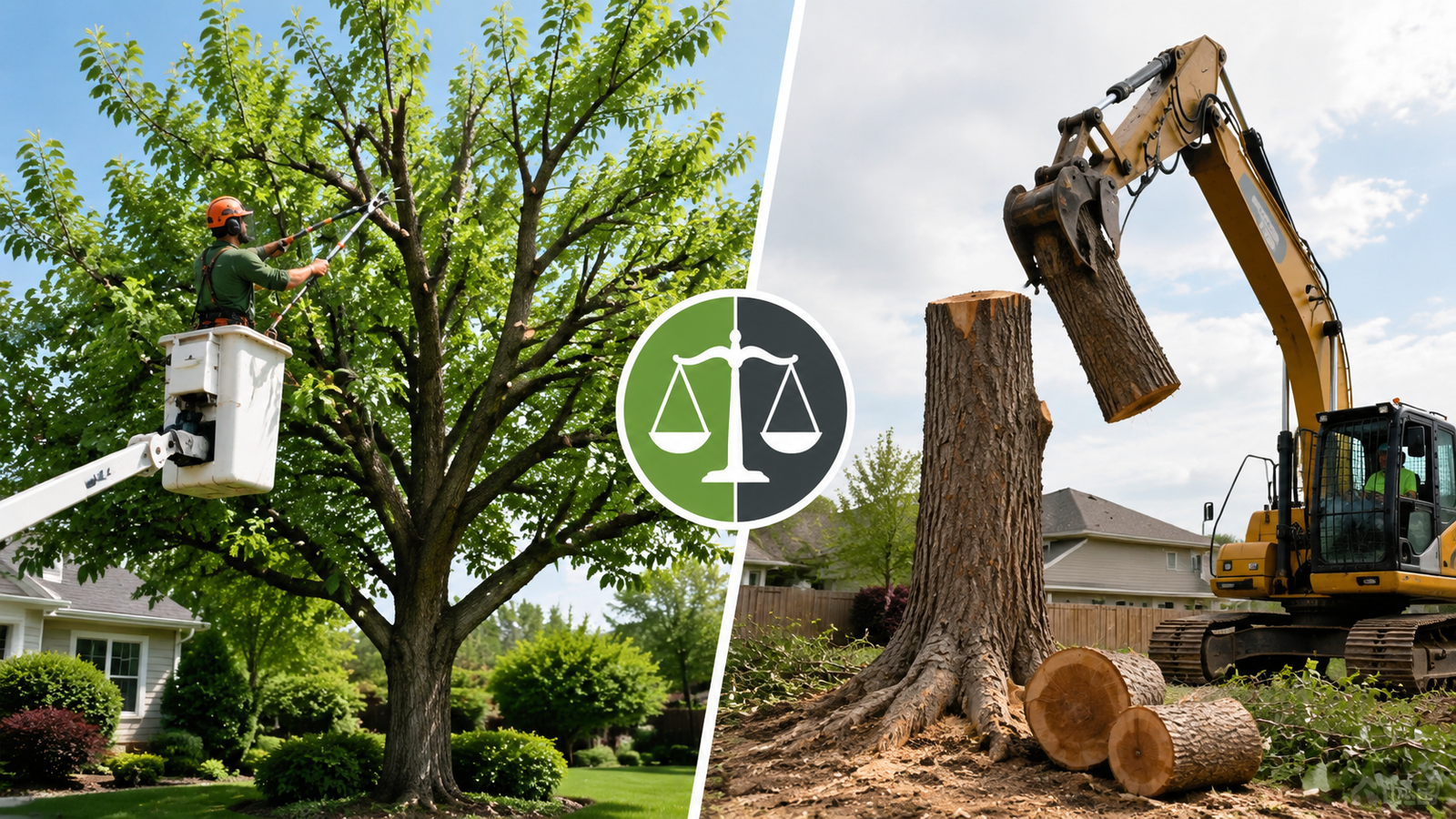
A mature tree can take 30, 50, even 100 years to grow but only one bad decision to lose forever. So when a branch starts scraping against your roof or a trunk begins to lean over the driveway, the first question most homeowners in Hull ask us is the same: “Does this tree need pruning, or does the whole thing have to come down?”
It’s a fair question, and the honest answer is it depends. Pruning and removal are two very different services with very different costs, outcomes, and consequences for your garden. Choose pruning when removal was needed, and you may be paying twice within a year. Choose removal when a sensible prune would have done the job, and you’ve lost a tree that could have lived for decades.
This guide walks you through exactly how to tell them apart, the warning signs to look out for, what UK law says about cutting down trees, and when to call a professional tree surgeon in Hull for an honest assessment.
What Is Tree Pruning?
Tree pruning is the selective removal of specific branches to improve the health, shape, structure, or safety of a tree. Think of it as preventative healthcare you’re not removing the tree, you’re maintaining it so it grows stronger, looks better, and stays safe for longer.
A skilled tree surgeon will prune to:
- Remove dead, diseased, or damaged branches before they fall
- Improve airflow and light penetration through the canopy
- Shape the crown so the tree grows in a balanced, attractive form
- Lift the lower branches away from buildings, paths, and roads
- Reduce weight on weaker limbs to prevent storm damage
- Encourage healthy new growth, flowering, and fruiting
Pruning is precise work. Done well, it’s almost invisible, the tree just looks healthier and tidier. Done badly, it can scar a tree for life, invite disease, or leave it structurally unsafe. This is why pruning sits at the heart of professional tree surgery, covering everything from light formative pruning on young trees to skilled crown lifting and deadwood removalon established specimens.
In casual conversation, people often use “trimming” and “pruning” interchangeably. Technically, trimming usually refers to lighter, more cosmetic work on smaller branches and is also commonly used for hedge cutting. Pruning is more deliberate and usually carried out with the tree’s long-term health in mind.
What Is Tree Removal?
Tree removal, sometimes called tree felling is the complete removal of a tree, including its trunk and (usually) its stump. It’s the option of last resort. A good tree surgeon will always try to save a tree first; removal only comes onto the table when pruning genuinely cannot fix the problem.
Removal might be carried out by felling (cutting the tree down in one piece, where there’s space) or by sectional dismantling (carefully lowering the tree section by section, used in tight gardens, near buildings, or close to power lines). Once the tree is down, the stump is usually ground out separately through a dedicated stump removal service to prevent regrowth and free up the space.
You’ll find more about how this works on our tree removal services in Hull page, but the key point is this: removal is permanent. Once a tree is gone, the shade, the privacy, the wildlife habitat, and the visual maturity it gave your garden are gone with it. That’s why this decision deserves real thought.
Pruning vs. Removal at a Glance
| Factor | Tree Pruning | Tree Removal |
| Purpose | Maintain and improve a healthy tree | Eliminate a tree that is unsafe, dead, or unwanted |
| Tree health | Tree is healthy or recoverable | Tree is dead, dying, or beyond saving |
| Permanence | Reversible the tree continues growing | Permanent the tree is gone for good |
| Frequency | Every 1–5 years depending on species | One-off |
| Cost (typical) | Lower usually a few hundred pounds | Higher often £400 to £2,000+ depending on size and access |
| Disruption | Minimal | Significant — heavy equipment, debris, clearance |
| Legal considerations | Usually straightforward | TPO, Conservation Area, and Forestry Act rules apply |
| Environmental impact | Preserves wildlife habitat and canopy | Loss of habitat, shade, and CO₂ absorption |
| Best for | Healthy trees needing maintenance | Hazardous, diseased, or dead trees |
When You Should Prune (Not Remove)
If your tree falls into any of the categories below, pruning is almost certainly the right answer. Removing a tree in these scenarios usually creates more problems than it solves.
1. The Tree Is Healthy but Overgrown
A tree that has simply grown larger than you’d like is rarely a reason for removal. Crown reduction, crown thinning, or crown lifting can bring the canopy back into proportion without sacrificing the tree itself.
2. There Are a Few Dead or Damaged Branches
Dead branches happen even on perfectly healthy trees. Selective deadwood removal clears the risk without touching the living structure. As a rule of thumb, if less than 25% of the canopy is affected, the tree is usually saveable.
3. Branches Are Touching Your House, Fence, or Gutters
Annoying, yes but not a death sentence for the tree. A skilled tree surgeon can carefully cut back the offending limbs and shape the canopy to stop the problem coming back for several years.
4. The Tree Is Casting Too Much Shade
Excessive shade can usually be solved through crown thinning (letting more light through the canopy) rather than removing the tree entirely.
5. You Want to Improve Fruit, Flower, or Foliage Quality
Pruning at the right time of year encourages better blossom, heavier fruit, and denser leaf growth. This is one of the most common reasons our customers in Hull book regular tree maintenance on apple, pear, plum, and ornamental species.
6. The Tree Is Young and Still Establishing
Formative pruning during the first 5–10 years of a tree’s life sets up the structure for the rest of its lifetime. Removal at this stage is almost always premature.
7 Warning Signs Your Tree May Need to Be Removed
Now for the harder side of the conversation. There are clear, observable signs that a tree has gone beyond what pruning can fix. If you spot any of the following on your property, book a professional inspection and in some cases, don’t wait.
1. The Tree Is Leaning Suddenly or Severely
Trees can grow at an angle and be perfectly stable. The danger sign is a new lean, especially with soil cracking, heaving, or exposed roots on the opposite side. That tells you the root plate is failing.
2. Large Sections of the Canopy Are Dead
If more than around a third of the crown is dead, leafless, or producing only small, sparse foliage, the tree is in serious decline. Pruning out the dead wood may buy a season or two, but removal is usually the responsible choice.
3. Major Fungal Growth on the Trunk or Roots
Brackets, conks, or honey fungus around the base or up the trunk are a red flag for internal decay. By the time fungi are visible on the outside, the rot is often well established inside the wood and a structurally compromised mature tree near a house is exactly the kind of risk our emergency tree services team gets called out to after a storm.
4. Deep Cracks, Splits, or Hollow Cavities in the Trunk
Vertical cracks, seams where two leaders are pulling apart, or a hollow you can put your hand into are signs the tree’s structural integrity is compromised. A hollow alone isn’t always fatal — many old oaks are hollow and stable but combined with other symptoms, it’s a serious concern.
5. Root Damage to Foundations, Drains, or Pavements
Aggressive root systems can lift driveways, crack patio slabs, and infiltrate clay drainpipes. In some cases, root pruning and barriers can resolve it. In other cases particularly with vigorous species too close to a building removal is the only long-term fix.
6. The Tree Has Been Damaged in a Storm
Major limb loss, snapped leaders, or trunk damage from high winds often leaves a tree both unstable and unable to recover. Hull’s exposed Yorkshire coastline location means we see this regularly through the autumn and winter storm season.
7. The Tree Is Dead
The most obvious sign of all and yet often the most missed. A dead tree may stand for months or even years before falling, but it will fall, and you don’t get to choose when. Dead trees within striking distance of a building, road, footpath, or neighbour’s property should be removed promptly.
What UK Law Says About Cutting Down Trees
This is where many homeowners get caught out. In the UK, you don’t always have the legal right to remove a tree on your own land. Before any felling work begins, check the following:
Tree Preservation Orders (TPOs)
A TPO is a legal protection placed on a specific tree, group of trees, or woodland by the local council. It is a criminal offence to cut down, top, lop, uproot, or wilfully damage a tree with a TPO without written permission. Fines can run into the thousands of pounds per tree. Hull City Council and East Riding of Yorkshire Council both maintain TPO records, which you can check before any work begins.
Conservation Areas
If your property sits within a Conservation Area, you generally need to give the local council six weeks’ written notice before pruning or felling any tree with a stem diameter of more than 75mm (about 3 inches) measured at 1.5m from the ground. The council can then decide whether to issue a TPO.
The Forestry Act 1967
For larger volumes of timber broadly, more than 5 cubic metres in any calendar quarter you may need a felling licence from the Forestry Commission. This rarely affects a single garden tree but does apply to landowners felling multiple trees or working in small woodlands.
Boundary and Neighbour Trees
If the tree sits on a boundary or in a neighbour’s garden, you can usually prune branches that overhang into your property but only back to the boundary line, and you should offer the cuttings back to the owner. Cutting beyond the boundary, or felling the tree entirely, requires the owner’s consent.
A reputable tree surgeon will always carry out these checks before starting work. If a contractor offers to fell a tree without asking about its protected status, treat that as a warning sign.
When Is the Best Time of Year?
Timing matters more for pruning than it does for removal but it matters for both.
Pruning is generally best carried out when a tree is dormant (late autumn through late winter), with two key exceptions:
- Cherry, plum, and other Prunus species should be pruned in summer to reduce the risk of silver leaf disease
- Oak and elm should be pruned outside the main beetle activity season (broadly avoid April to August in the UK) to reduce the risk of oak wilt and Dutch elm disease
Light formative pruning and deadwood removal can usually be done at any time of year. Heavy crown reduction should be planned around the species.
Tree removal can technically happen year-round, but winter is often preferred the ground is firmer, frozen or dormant lawns are easier to protect, there are no leaves to clear up, and you’ll avoid disturbing nesting birds. Under the Wildlife and Countryside Act 1981, it is illegal to disturb nesting birds, so any tree work between roughly March and August needs a careful nest check before the chainsaw starts.
What Does It Cost?
Prices vary considerably depending on tree size, species, access, location, and what’s done with the timber afterwards. As a rough guide for tree work in Hull and the surrounding East Yorkshire area:
- Light pruning of a small to medium tree: £150–£400
- Crown reduction or thinning of a larger tree: £400–£900
- Full removal of a small to medium tree: £400–£900
- Removal of a large, mature tree in a tight garden: £1,000–£2,500+
- Stump grinding (separate cost): £80–£250 per stump
Always get a written quote, ideally from a tree surgeon who’s visited the site. Beware of suspiciously cheap quotes proper insurance, qualified climbers, and safe equipment all cost money, and the savings on cut-price work tend to disappear the moment something goes wrong. You can read more about our pricing approach and credentials on our about us page.
How to Decide: A Simple Framework
If you’re still not sure, work through these four questions in order:
- Is the tree dead or beyond saving? If yes, plan for removal.
- Is the tree a clear safety risk to people or property? If yes, get a professional inspection urgently and budget for either heavy remedial work or removal.
- Can the problem be solved by selectively removing some branches? If yes, pruning is almost certainly the right choice.
- Are you removing it purely for convenience or preference? If yes, pause. Check whether there’s a TPO, talk to neighbours, and ask whether pruning could give you 80% of the benefit at 30% of the cost.
When in doubt, get a professional opinion before the chainsaw comes out. A 20-minute site visit from a qualified tree surgeon is worth far more than a guess based on a Google search.
Why a Professional Assessment Is Worth It
DIY tree work is one of the most common causes of serious garden injuries in the UK every year and one of the most common causes of unnecessary tree loss. A professional tree surgeon Hull homeowners trust will:
- Identify diseases and structural problems most people would miss
- Check for TPOs and Conservation Area restrictions before quoting
- Carry full public liability insurance (typically £5 million minimum)
- Use proper climbing, rigging, and felling techniques to protect your property
- Clear up properly afterwards, including chipping brush and removing logs
At A1 Tree Services, we’ve been looking after trees across Hull, Cottingham, Hessle, Willerby, Beverley, and the surrounding East Yorkshire villages for over 20 years. We’ll always tell you honestly when a tree can be saved and equally honestly when it can’t.
Frequently Asked Questions
Can a tree recover after heavy pruning?
Yes, in most cases provided no more than around 25% of the live canopy is removed in a single session. Heavier reductions can stress the tree, slow its recovery, and in some species (especially older specimens) can be fatal. This is why professional tree surgeons follow British Standard BS 3998 for tree work.
Will a removed tree grow back from the stump?
It can. Many UK species including willow, sycamore, ash, and lime will throw up vigorous suckers from a cut stump. If you don’t want this, the stump needs to be ground out or chemically treated as part of the stump removal process.
Do I need permission to prune my own tree?
Usually not but always check for a TPO and Conservation Area status first. If either applies, you need written consent from the council before doing anything more than light deadwood removal.
How often should trees be pruned?
It depends on the species, age, and location. Young trees benefit from formative pruning every 1–2 years. Mature ornamental trees in domestic gardens are typically pruned every 3–5 years. Fruit trees often need annual attention. Trees near buildings or footpaths usually need more frequent work than those in open ground.
Can I prune a tree myself?
For small, accessible branches with secateurs or loppers from ground level, yes. For anything that needs a ladder, chainsaw, or climbing please don’t. Falls from height and chainsaw injuries cause hundreds of hospital admissions every year in the UK. Hire a qualified tree surgeon.
What happens to the wood after removal?
A good tree surgeon will chip the brush on site, then either take the timber away or if you’d like it cut it into logs and stack it for you. As an eco-friendly company, we recycle as much of the collected natural material as possible.
My tree has been damaged in a storm is it an emergency?
If branches are blocking access, hanging dangerously, or the tree is leaning over a building or road, yes. Don’t wait. Call our emergency tree services line on 01482 699534 and we’ll get to you as fast as possible.
Get Expert Advice Before You Decide
Whether you need a single branch pruned back from a conservatory roof or a large, dying tree taken down safely from a tight Hull garden, the right answer always starts with a proper assessment. We’ll come out, take a look, and give you a straight, honest opinion including the option of saving the tree wherever we can.
Call A1 Tree Services on 01482 699534 orget in touch through our contact page for a free, no-obligation quote. We cover Hull, Cottingham, Hessle, Willerby, Beverley, Hedon, Anlaby, and all surrounding East Yorkshire villages.
Comments are closed