
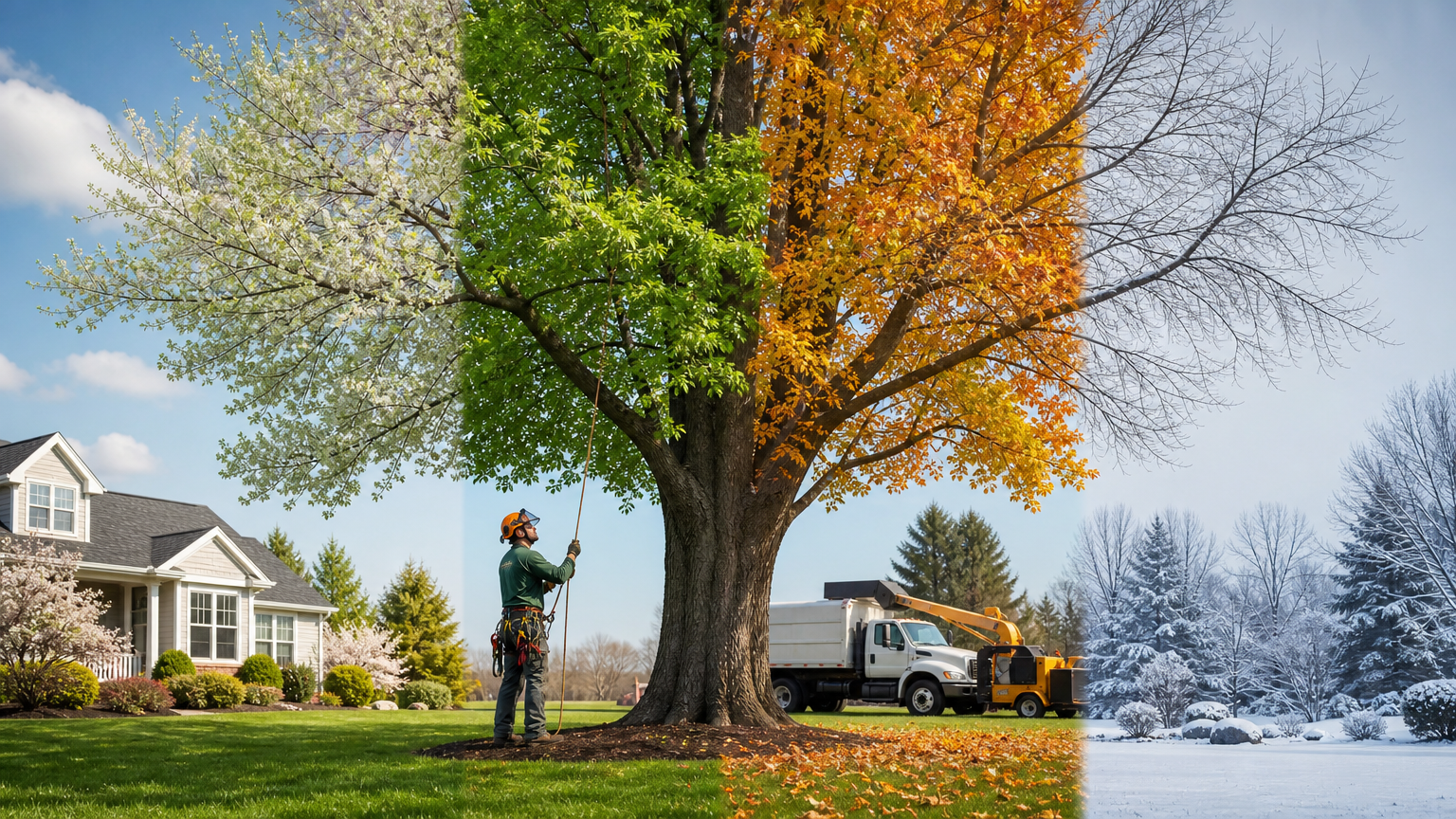
If you’ve been looking at the trees in your garden and wondering whether now is the right time to call in a professional, you’re not alone. It’s one of the most common questions our team at A1 Tree Services gets asked. The honest answer is: it depends on the type of work needed, the species of tree, and what’s going on in your garden right now.
In this guide, we’ll walk you through every season, explain which tree surgery services are best suited to each time of year, and help you understand when you simply can’t wait, no matter the season.
Why Timing Matters for Tree Services
Trees are living organisms with seasonal growth cycles. Work carried out at the wrong time of year can stress the tree, slow its recovery, make it more vulnerable to disease and pests, or even cause lasting damage. On the other hand, choosing the right moment means faster healing, healthier regrowth, and better results overall.
That said, timing is not always about achieving the ideal, sometimes safety has to come first. A dead branch hanging over your roof or a storm-damaged tree leaning towards your neighbour’s fence can’t wait for the perfect season. Our emergency tree services in Hull are available whenever urgency demands it.
Season-by-Season Guide to Tree Services in Hull
Winter (December – February): The Best All-Round Window
Winter is widely regarded by arborists as the optimal time for the majority of tree surgery work, and for good reason.
During the colder months, most deciduous trees enter a dormant period — they stop actively growing, their sap movement slows significantly, and they’re not drawing on stored nutrients for new growth. This means:
- Pruning cuts heal more efficiently: the tree can put its energy into wound repair without competing demands.
- The structure is fully visible with leaves gone, your tree surgeon can clearly assess the tree’s framework, identify weak unions, crossing branches, and areas of dead wood.
- Pest and disease transmission is reduced; many fungal pathogens and insects are inactive in cold weather, so open pruning wounds are at lower risk.
- Ground conditions are often firmer making access easier and reducing damage to lawns and surrounding areas.
If you’re planning significant tree removal in Hull, crown reduction, pollarding, or structural pruning, late December through to February is frequently the best window. This is also an excellent time to get your stump removal booked in clearing stumps from trees felled earlier in the year before the ground softens in spring.
Hull Tip: Hull’s East Yorkshire winters can be damp and windy. Getting tree work done before harsh weather arrives means you’re not leaving weakened or partially worked trees exposed to storm damage.
Spring (March – May): Great for Some Work, Avoid for Others
Spring is a period of intense biological activity for trees. As temperatures rise, dormant buds break, new leaves emerge, and the tree draws heavily on its stored reserves. This makes spring a nuanced time for tree services.
Good for spring:
- Planting new trees warming soil and spring rainfall help newly planted trees establish their root systems before summer.
- Crown lifting raising the lower canopy to improve access or light can be done in early spring with minimal impact.
- Deadwood removal dead branches carry no seasonal significance and can be removed any time.
- Hedge trimming light shaping of hedges in early spring encourages dense, healthy growth. See our hedge trimming services in Hull for more.
Avoid in spring:
- Heavy pruning or crown reduction during the active growing season disrupts the tree’s growth cycle and can lead to stunted development or vulnerability to disease.
- Trees are drawing upon stored energy to fuel new growth interrupting this process through major pruning can weaken them at a critical time.
Important legal note for spring: The UK’s bird nesting season runs primarily from March to July. All nesting birds, their eggs, and their young are protected under the Wildlife & Countryside Act 1981. Before any tree work during this period, a nest check must be carried out. If active nests are found, work must be paused until the birds have fledged. Our qualified team always checks for nesting activity before commencing any spring or summer work.
Summer (June – August): Monitoring, Maintenance & Emergencies
Summer is generally not the preferred season for significant tree surgery. Trees are at the peak of their growing season, and heavy pruning during this time can disrupt their natural rhythms and leave wounds more exposed to pathogens.
However, summer does have its place in the tree care calendar:
- Tree health assessments with full foliage in place, summer is actually the ideal time to spot problems. Discoloration, unusual leaf drop, pest damage, fungal growth, and die-back are all far easier to identify when the tree is in full leaf.
- Deadwood removal can be safely carried out year-round and is particularly useful in summer when dead branches are easy to distinguish from living ones.
- Emergency tree work storms, high winds, and summer downpours can cause sudden structural failures. If you have a tree that has fallen or poses an immediate risk to people or property, our emergency tree team in Hull responds quickly, regardless of the time of year.
- Hedge trimming many hedging species benefit from a mid-summer trim to keep them tidy through the second half of the year.
One important species exception: Walnut trees should actually be pruned in summer (mid-summer to early autumn), not during dormancy. When pruned in winter, walnuts are prone to excessive sap bleeding through open wounds, which can cause stress and nutrient loss.
Autumn (September – November): Preparing Your Trees for Winter
Late autumn is another excellent window for tree work, sitting alongside winter as one of the most productive periods of the year.
As trees begin to pull nutrients back from their leaves before leaf fall, early pruning in autumn can deprive them of those essential reserves so early autumn is best avoided for heavy work. However, once leaf fall is well underway in late October and November, conditions improve considerably:
- Trees are entering dormancy, and pruning cuts made now will begin healing over winter.
- The canopy is thinning, giving tree surgeons better visibility of the structure.
- Ground conditions are typically still firm enough for equipment access.
- It’s a practical time for tree removal services ahead of winter, and for removing any trees affected by summer storm damage.
- Stump grinding after autumn removals means the area is clear and ready for replanting or landscaping in spring.
Late autumn is also a smart time to carry out a proper tree inspection. Our team can assess any concerns structural weakness, decay, leaning trees, or canopy problems, so you have a clear plan before winter weather puts additional stress on your trees.
The Best Time for Each Type of Tree Service
Different services have their own ideal timing, and it’s worth understanding this before you book:
| Service | Best Time | Can It Be Done Year-Round? |
| Crown Reduction | Late autumn / winter / early spring | Not recommended mid-summer |
| Crown Lifting | Dormant season preferred | Yes, with minimal impact |
| Crown Thinning | Winter / early spring | Best avoided in summer |
| Pollarding | Winter / early spring | No — avoid summer |
| Deadwood Removal | Any time | Yes |
| Tree Felling / Removal | Dormant season preferred | Yes, if urgent |
| Stump Removal | Any time (firmer ground in winter) | Yes |
| Hedge Trimming | Spring & late summer | Yes, avoiding nesting season |
| Emergency Tree Work | Any time | Yes — 24/7 |
What About Specific Tree Species?
The species of tree on your property also plays a significant role in timing. A few examples:
- Oak avoid pruning between April and June when the risk of oak wilt (spread by beetles active in warm months) is elevated. Late summer and winter are preferred.
- Cherry, plum & other Prunus species prune in summer to reduce the risk of silver leaf disease entering fresh wounds during the wetter autumn and winter months.
- Walnut prune in mid to late summer to avoid sap bleeding.
- Beech & Horse Chestnut best pruned in late winter to early spring.
- Birch avoid late winter/early spring pruning as these trees bleed sap heavily; late summer is preferable.
This is another reason why working with a qualified, experienced tree surgeon matters. Our team at A1 Tree Services understands the specific requirements of the tree species most commonly found in Hull and East Yorkshire gardens.
When You Can’t Wait: Emergency & Safety-First Situations
There are situations where the season simply doesn’t matter where waiting risks safety, property, or life.
You should contact a professional immediately, regardless of the time of year, if:
- A tree has fallen or is leaning suddenly following a storm
- A branch is overhanging power lines or a neighbour’s property and posing a risk
- You notice significant decay, fungal growth, or large hollow sections in a tree trunk
- A tree has been struck by lightning
- Roots are visibly lifting, cracking, or undermining structures
Our emergency tree services are available across Hull and the surrounding areas whenever you need us.
What Happens If You Skip Regular Tree Maintenance?
Neglecting seasonal tree maintenance isn’t just an aesthetic problem, it’s a safety and cost issue over time. Trees with unchecked growth, dead wood, or structural imbalances are more likely to fail during storms, more likely to spread disease to neighbouring trees, and significantly more expensive to deal with when the situation becomes urgent.
Regular tree maintenance tailored to each season protects your investment in your property, extends the life of your trees, and keeps your outdoor space safe and enjoyable. Our team offers both one-off services and ongoing maintenance packages for domestic and commercial clients across Hull and the East Riding of Yorkshire.
Hull’s Local Climate: A Practical Factor
Hull sits on the Humber estuary and is exposed to strong east winds, heavy rainfall periods, and occasionally severe winter storms. This local context is worth factoring into your tree care schedule:
- Pre-winter inspections in October–November are particularly valuable in Hull, where trees may be exposed to coastal-influenced winds during winter storms.
- Spring nest checks are essential, as many bird species nest in garden trees across Hull’s residential areas.
- Post-storm assessments are a regular necessity, our emergency tree work team is experienced in dealing with the aftermath of Hull’s frequent winter gales.
How to Book Tree Services in Hull
Whether you need pruning, removal, stump grinding, hedge trimming, or an urgent emergency callout, A1 Tree Services has the experience and qualifications to help. We serve Hull and surrounding areas including Cottingham, Beverley, Hessle, Anlaby, Willerby, and across the East Riding.
Here’s how we work:
- Free consultation and quote we assess your trees and advise on the best course of action and timing.
- Scheduled works we plan around the ideal seasonal window for your specific needs.
- Professional, insured service all work is carried out to industry standards, fully insured, with full site clearance included.
Ready to get started? Contact our team or call 01482 699534 for a free, no-obligation quote.
Frequently Asked Questions
What is the best time of year to hire a tree surgeon in Hull?
For the majority of tree surgery work including pruning, crown reduction, and tree removal late autumn through to late winter (November to February) is the optimal window. Trees are dormant, the structure is visible, and healing is efficient. That said, the right time always depends on the specific service and tree species involved.
Can tree work be done in summer?
Yes, but with caveats. Deadwood removal, health assessments, hedge trimming, and emergency work can all be carried out in summer. Heavy structural pruning and crown reduction are generally best avoided until the dormant season.
Is there a season when tree surgery is cheapest?
Demand for tree services in Hull tends to peak in spring and early summer. Booking during winter months particularly January and February can sometimes mean quicker availability and more flexibility on scheduling.
Do I need planning permission to have a tree removed in Hull?
If your tree is protected by a Tree Preservation Order (TPO) or sits within a Conservation Area, you will need consent from East Riding of Yorkshire Council or Hull City Council before any work begins. Our team can advise you on this during your initial assessment.
What are the signs a tree needs urgent attention?
Sudden leaning, large cracks in the trunk, extensive dead branches, fungal growth at the base, or root heaving are all warning signs that a tree needs professional attention as soon as possible. Contact our emergency tree service if you have immediate concerns
Final Thoughts
There’s no single “perfect” time to hire a tree service, it depends on what your trees need and what you’re trying to achieve. But understanding the seasonal patterns covered in this guide gives you a significant advantage in planning your tree care effectively and getting the best possible results.
If you’re unsure where to start, our experienced team is happy to visit your property, assess your trees, and give you honest, tailored advice — with no obligation to book. From routine tree surgery and hedge trimming to stump removal and emergency callouts, A1 Tree Services is Hull’s trusted choice for professional, year-round tree care.
Comments are closed