
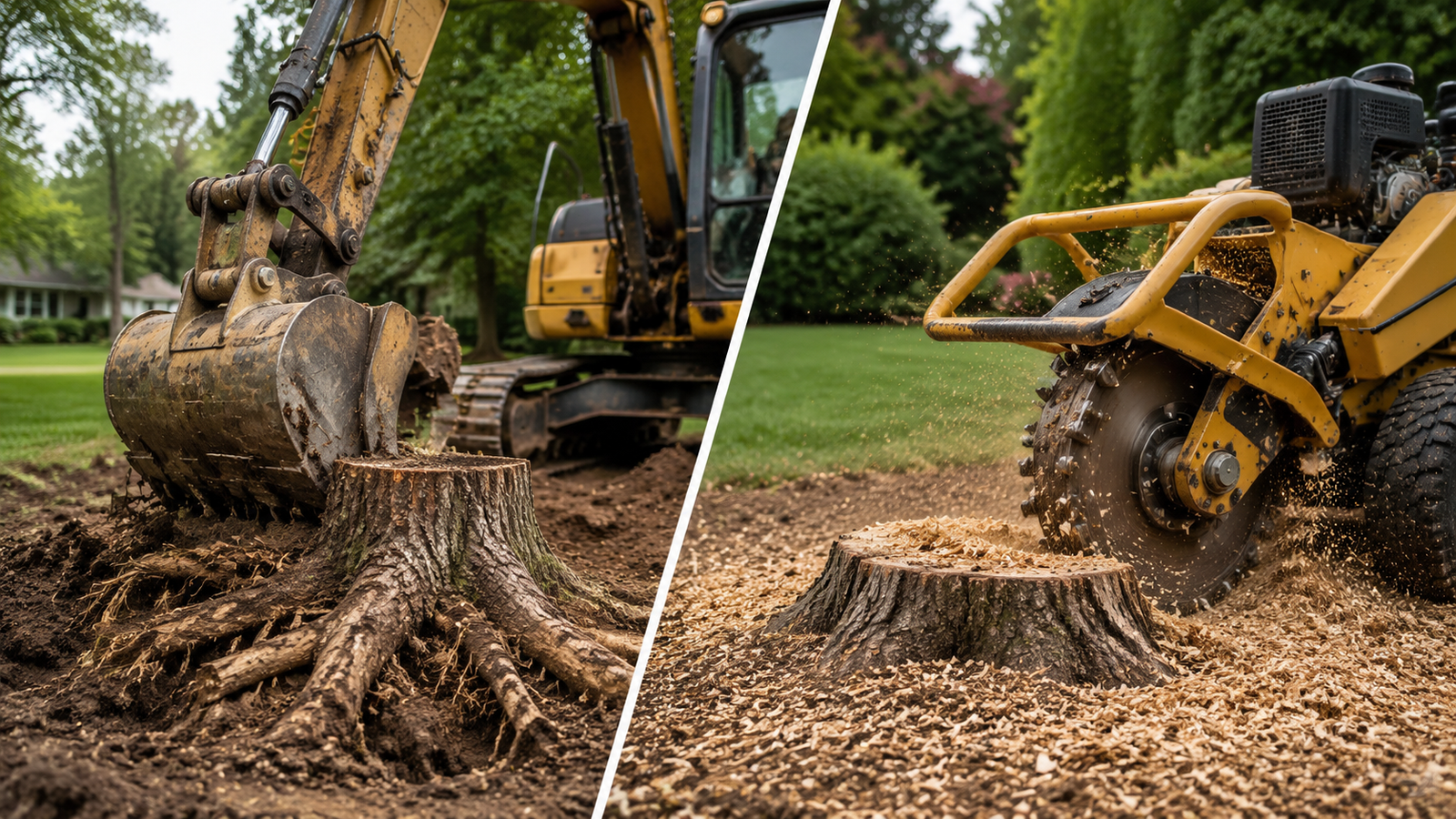
Once a tree has been felled, you’re usually left with one stubborn reminder of it: the stump. And while it might look harmless sitting there in the corner of your garden, that stump is rarely something you want to keep. The question almost every homeowner in Hull eventually asks is a simple one, should I grind it down, or have the whole thing dug out?
The two options sound similar, but they’re genuinely different jobs with different costs, timescales, and end results. Choosing the wrong one can mean paying for work you didn’t need, or worse, discovering months later that the stump you “removed” is sending fresh shoots up through your new lawn.
This guide breaks down stump removal versus stump grinding in plain terms, what each method actually involves, what it costs in the UK in 2026, the pros and cons of each, and a straightforward way to decide which is right for your property. By the end, you’ll know exactly which option to ask for when you call a tree surgeon.
Why Bother Removing a Tree Stump at All?
Before comparing the two methods, it’s worth being clear on why a leftover stump is a problem. A stump isn’t just an eyesore, although it certainly can be one. Left in place, it brings a handful of practical headaches:
- It’s a trip hazard. A low stump hidden in grass is easy to catch a foot or a mower blade on, especially for children and elderly visitors.
- It attracts pests. Decaying wood is a magnet for wood-boring beetles, ants, and fungi, and those pests can spread to healthy trees, fences, and even your home.
- It can regrow. Plenty of common species, sycamore, willow, poplar, cherry will happily throw up new suckers from a living stump, leaving you with a thicket where you wanted a clear lawn.
- It wastes space. A stump and its roots can block new planting, paving, an extension, or a shed for years.
- It spoils the look of your garden. If you’ve invested in landscaping, a rotting stump undoes a lot of that effort.
Whether you grind or fully remove it, getting rid of the stump solves these problems. The difference is in how thoroughly, and at what cost. If you’ve only just had the tree taken down, our tree removal services and stump removal are often booked together as a single job.
What Is Stump Grinding?
Stump grinding uses a purpose-built machine, a stump grinder fitted with a fast-spinning cutting wheel studded with carbide teeth. The grinder chews the stump down into a pile of fine wood chips, working from the top down and across, until the stump sits well below ground level (typically 15–30cm, or 6–12 inches, beneath the surface).
Crucially, grinding deals with the part of the stump you can see, plus a little below. The wider root system stays in the ground and is left to rot down naturally over the following months and years. The hole left behind is shallow and is usually filled with the wood chippings the machine produces, leaving a level, tidy surface you can turf over or plant on top of fairly quickly.
Pros of Stump Grinding
- Faster. Most domestic stumps are done within a couple of hours.
- Cheaper. Less labour and no major excavation keeps the price down.
- Far less mess and disruption. No large hole, no heavy digging, and surrounding lawn, beds, and paths stay largely undisturbed.
- Useful by-product. The wood chips can be reused as mulch on your borders.
- Better near buildings. Grinding is safer than digging close to walls, fences, drains, and utility lines where excavation could cause damage.
Cons of Stump Grinding
- The roots stay put. They decay slowly underground, which is fine for most gardens but not ideal if you need a completely clear root zone.
- Possible regrowth. Vigorous species can still send up shoots from the roots left behind.
- Not suitable for building. If you’re putting up an extension or laying foundations, leftover roots can get in the way.
What Is Stump Removal?
Stump removal, sometimes called full extraction or “digging out”, is the more thorough and more invasive of the two. Instead of grinding the visible stump away, the entire stump and its root ball are dug out of the ground and hauled away completely.
This is a bigger operation. Depending on the size of the stump and how easy it is to reach, it usually means a mini excavator or specialist tools, with the arborist exposing and severing the major roots before levering the whole structure out. Once it’s gone, you’re left with a sizable hole that needs backfilling with topsoil before the ground is usable again.
Because it’s heavier work involving machinery and more labour, stump removal takes longer and costs more but it leaves you with a genuinely clean, root-free site.
Pros of Stump Removal
- Completely gone. Stump and roots are both removed, leaving nothing behind.
- No regrowth, ever. With the roots out, there’s zero chance of new shoots.
- Ready to build or replant. A fully cleared root zone is essential for foundations, paving, or planting a new tree in the same spot.
- Eliminates disease at the source. If the stump is infected (for example with honey fungus), full removal stops it spreading.
Cons of Stump Removal
- More disruptive. Heavy machinery and a large hole mean significant ground disturbance.
- More expensive. More labour, equipment, and disposal costs push the price up.
- Garden recovery needed. The surrounding soil, lawn, and nearby plants may be disturbed and need restoring afterwards.
Stump Grinding vs Stump Removal: Side-by-Side Comparison
| Factor | Stump Grinding | Full Stump Removal |
|---|---|---|
| What’s removed | Visible stump + 15–30cm below ground | Entire stump and full root ball |
| Roots | Left to decay naturally | Completely extracted |
| Typical time | 30 mins – 2 hours | Half a day to multiple days |
| Disruption | Minimal | Significant — large hole, machinery |
| Cost (UK 2026) | ~£100–£500 per stump | ~£150–£400+ per stump |
| Regrowth risk | Low, but possible on vigorous species | None |
| Suitable for building? | No | Yes |
| Mess afterwards | Wood chips (reusable as mulch) | Large hole needing backfill |
| Best for | Quick, tidy, budget-friendly clearing | Construction, replanting, full clearance |
How Much Does Each Method Cost in the UK?
Cost is usually the deciding factor, so it helps to go in with realistic figures. Bear in mind these are general 2026 UK guide prices, the only way to get an accurate number is an on-site assessment, because size, species, soil, and access all move the needle.
According to Checkatrade, professional stump grinding can cost as little as £160–£220 for a trunk under half a foot in diameter, rising to £500–£710 for larger stumps that need more powerful machinery. Other UK trade-pricing sites put the typical range a little lower, with stump grinding averaging between £100 and £500 per stump and full extraction of the entire stump and root system costing more because of the extra labour and machinery involved.
A few things that push the price in either direction:
- Size and diameter a wide, mature stump takes far longer than a slender one.
- Species and root spread sprawling root systems mean more work, especially for full removal.
- Accessing a stump a machine can reach is cheaper than one tucked behind a narrow side gate that needs hand tools.
- Soil conditions rocky or compacted ground slows grinding down.
- Number of stumps many tree surgeons offer a discount when clearing several at once.
It’s also worth knowing that hiring the equipment yourself is rarely the saving it looks like: stump grinder rentals run to around £250–£380 per week, and buying one costs £1,300–£1,600 before you factor in the genuine risk of operating heavy cutting machinery without training.
So, Which Should You Choose?
Here’s the simple version. The right method comes down to what you plan to do with the space, your budget, and the type of tree you’re dealing with.
Choose Stump Grinding If…
- You want the stump gone quickly and affordably.
- You’re not planning to build on the spot.
- You’re happy for the roots to decay naturally underground.
- The stump is close to a wall, fence, drain, or path where digging could cause damage.
- You just want a tidy, level surface to turf or plant over.
For the large majority of Hull gardens, grinding is the sensible, cost-effective choice.
Choose Full Stump Removal If…
- You’re planning construction, an extension, paving, or a driveway over the area.
- You want to plant a new tree in exactly the same spot (leftover roots interfere with new growth).
- The tree is a vigorous regrower sycamore, poplar, willow, cherry and you want zero chance of suckers.
- The stump is diseased and you need it gone to protect surrounding trees.
- You simply want the area completely clear, roots and all, with no compromises.
If you’re still not sure, that’s exactly the sort of thing to ask about during a free quote, a good arborist will look at the stump, your plans, and the ground, and tell you honestly which option makes sense rather than upselling you the bigger job.
A Note on the Environment
Grinding is often the greener option day-to-day: it leaves the roots in place to break down naturally, which feeds soil organisms, and it turns the stump into mulch you can reuse rather than waste you have to cart away. Full removal is more disruptive to the surrounding soil. The one big exception is disease, if a stump is infected, removing it entirely is usually the responsible choice to stop the problem spreading. As an eco-conscious team, we recycle the bulk of the green waste we collect across our tree surgery and stump work.
Why Use a Professional Rather Than DIY?
It’s tempting to tackle a small stump yourself, but both grinding and removal carry real risks. Stump grinders are powerful, fast-spinning machines that can throw debris and cause serious injury in untrained hands. Digging a stump out by hand is back-breaking and frequently underestimates how far roots spread. And in both cases there’s the hidden danger of striking buried pipes, cables, or drains.
A qualified, insured tree surgeon brings the right machinery, knows how to assess the stump and ground first, and clears up properly afterwards. At A1 Tree Services we’ve cared for trees across Hull and the surrounding villages for over 20 years, and stump work — whether a quick grind or a full dig-out — is part of what we do day in, day out. If a fallen or storm-damaged tree has left you with an urgent problem, our emergency tree services can help too.
Frequently Asked Questions
Does stump grinding remove the roots?
No. Grinding removes the visible stump and a little below ground level, but the wider root system stays in the soil and decays naturally over time. If you need the roots gone, you want full stump removal.
Can a stump grow back after grinding?
It can, on vigorous species like sycamore, poplar, and willow, which may send up shoots from the remaining roots. If you want to guarantee no regrowth, choose full removal, or ask your tree surgeon about treating the stump.
Is stump grinding messy?
It produces a pile of wood chips, but these are easily cleared or better still, reused as mulch on your borders. There’s no large hole and very little disturbance to the surrounding garden.
Which is cheaper, grinding or removal?
Grinding is almost always the cheaper of the two, because it needs less labour and no major excavation. Full removal costs more but gives you a completely clear, root-free site.
How long does each take?
A typical garden stump can be ground down in 30 minutes to two hours. Full removal takes longer from half a day up to multiple days for very large, established stumps.
Can I plant a new tree where the old one was?
If you’re replanting in the exact same spot, full removal is best, as leftover roots can interfere with the new tree establishing. If you’re planting elsewhere in the garden, grinding is usually fine.
Do I need permission to remove a tree stump?
Removing a stump from a tree that’s already been felled generally doesn’t need permission. However, if the tree is still standing and protected by a Tree Preservation Order or sits in a conservation area, you’ll need approval before any work is check first.
Ready to Clear That Stump?
Both stump grinding and full removal have their place, the best choice simply depends on your plans, your budget, and the tree itself. For most gardens, grinding is the quick, affordable answer; for building projects, replanting, or stubborn regrowers, full removal is worth the extra.
Still not sure which you need? Don’t guess. The team at A1 Tree Services will assess your stump, talk through your plans, and recommend the right approach with a free, no-obligation quote. Get in touch today or call 01482 699534 to book your stump grinding or removal in Hull and the surrounding areas.
Comments are closed